
THE ROOM
Inside The Ponderosa

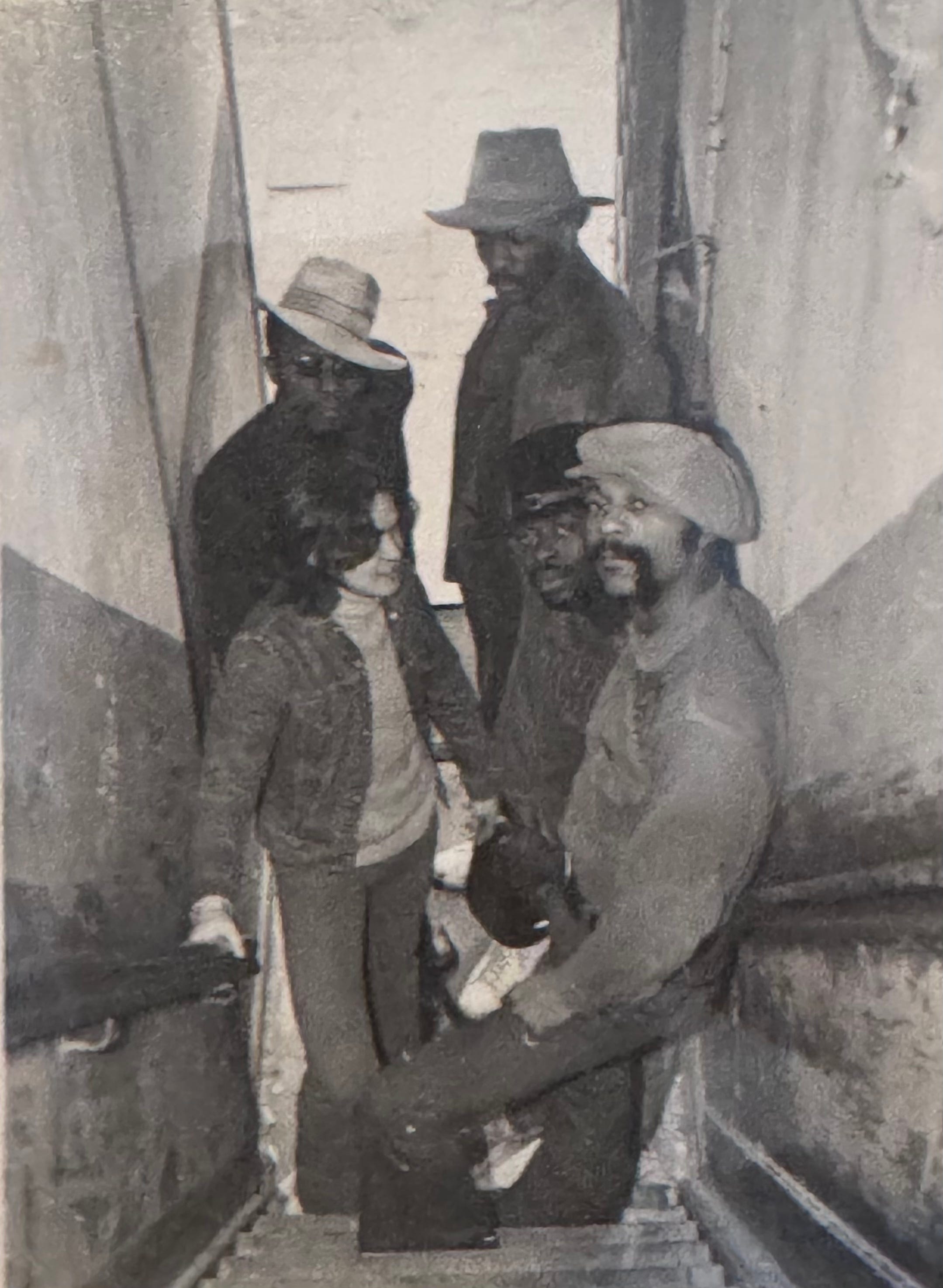
CARIBBEAN NIGHTS
The music was coming through the walls before we even got out of the van.
We’d been on the road twenty hours, and finally made it into Amsterdam. We found it on a map I’d bought at the French border, the detailed one, the expensive one. I loved the maps with the most detail and was constantly harassed about it because they cost considerably more. Even then I had a lust for detail, and who knew fifty years later I’d have the choice of Apple Maps, Google or Waze. If only we’d had that then. When we finally found our way there all we had was a name on a piece of paper and a gigantic map you had to spread all over yourself and the person sitting next to you. No agency, no contact number, no plan beyond the address written on that piece of paper: 5 Warmoesstraat. Five minutes from Central Station if you knew where you were going. We didn’t.
Warmoesstraat
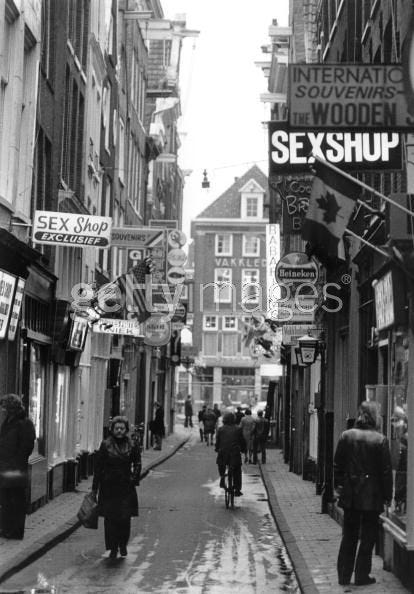
Getting in was its own adventure. Warmoesstraat is so narrow you can barely fit a van through it, and you can only enter from Damrak or a back street that feeds into it from behind. We drove through what felt like the gap between two buildings and came out the other side onto this strip of leaning brick that looked like it had been designed by someone who’d had too much to drink. Classic Dutch architecture, the facades tilting out toward the street, held up by beams that angled down to the pavement like crutches. I kept waiting for one of them to go. Every other shop window had dildos and a new world of sexual paraphernalia I’d never imagined in my wildest dreams. There were live sex shows. There was a sex venue that looked like it had been open since before the war. None of us said anything for a few minutes. We’d come from a castle in Sitges. Before that, California. This was a different planet.
We’d also never seen that concentration of Black people in a long time. That registered before anything else did. Not in Spain, not crossing France, not anywhere since we’d left Los Angeles. And here on this narrow strip in the middle of Amsterdam “we” were everywhere, men hustling whatever they could, women, Dutch and Surinamese, on the streets in ridiculously short skirts, kids on steps. We found out later that most of the immigrant population were from Surinam and Curaçao, the Dutch Caribbean community that had been settling in Holland for decades. The Netherlands had colonised Surinam in 1667, and when independence finally came in the 1970s a large portion of the people came with it, hoping for a better life and looking to avoid the impending economic decline. It was an exercise in immigration 101 that would end up challenging both the Dutch and the Surinamese population in ways I’d only begin to understand later. The question that process always raises is whether the people who migrate to your country are solely responsible for fitting in, learning the language and customs and making themselves invisible, or whether the host nation has any obligation to be flexible enough to embrace some of what the arriving culture brings with it. People who arrive generally come with some kind of trauma from wherever they left. I’ll leave that thought with you for now. I never realized the word apartheid was a Dutch word until I half-heard a speech Prime Minister Botha of South Africa was making on television one night and recognized it.
We found the Ponderosa
Albert was a very different man from Pepe. Soft spoken, but there was no doubt he was a gangster, with that particular confidence that made you feel he was relaxed and generous if he liked you, and something else entirely if he didn’t. Together with his partner, who we only ever knew as Boy, he controlled the heroin traffic, the nightlife, and the inner city entertainment in that neighbourhood. Most of the people who came to the club had money to burn. The crowd was primarily Black but a few Dutch dealers were honorary members, the Eminems of the seventies, and everyone operated with a calm respect for one another. We were just beginning to see the multicoloured tapestry they were weaving and how the system worked. Albert and Boy were the underground entertainment magnets of Warmoesstraat. What I can tell you is that within the first hour of meeting him Albert had offered us the upstairs floor to stay on until we found somewhere permanent, fed us, and explained how Amsterdam actually worked. He had the kind of calm that comes from watching foreigners arrive confused and leave knowing something. He’d seen it all before, but he hadn’t seen a group of people with the kind of nerve we had. Our determination to play relentlessly, camp out in that room, and operate with a play-or-die attitude eventually earned his respect.
We had two kids with us and a pregnant woman, Willie’s wife Susie, and three families’ worth of clothes, toys, personal luggage, music equipment, and no idea where to start looking for accommodation. We kept asking Albert about agencies, about finding a place to rent, which we assumed would be a normal process. He’d listen patiently, but we always got the same answer. People from the neighbourhood would drift in and out and we’d ask them too, and every single one said the same thing.
*Beenje inschreiv?*
Are you written in? Registered at the city hall, the gemente. That was the Dutch system. You registered with the municipality and the municipality found you housing. You couldn’t rent privately the way we understood renting. You had to be in the system. We weren’t in the system and we didn’t want to be. We didn’t know how long we were staying, we had no intention of committing to anything official, and we had enough on our hands just getting the equipment sorted and everybody settled. So we did what you do when you have nowhere to go and someone offers you a room. We took it
THE ROOM
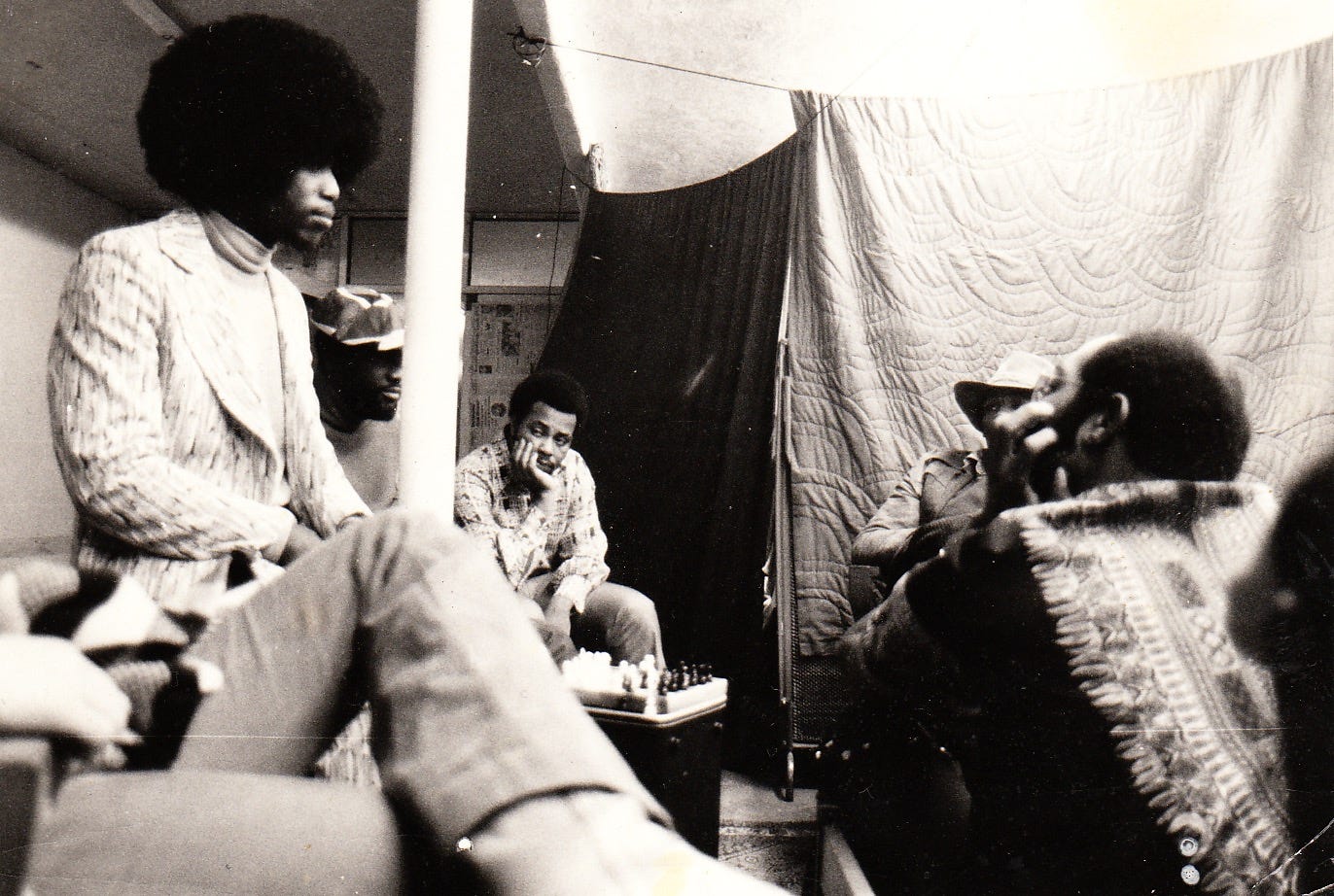
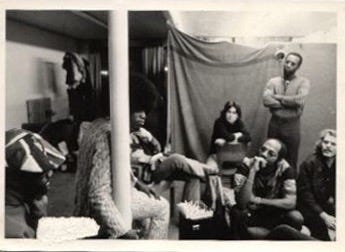
Upstairs from the club was one large room with bay windows that looked out over the canal and Damrak. There were a couple of support poles in the middle. The mothers immediately went to work, stringing clothesline between the poles and the walls, hanging blankets from the lines, building three tent corners, one for each family, private enough that you couldn’t see inside. The rest of the space had some chairs and five mattresses on the floor. That was where the single men slept. That was also where everyone gathered after the gig, where the days were spent playing chess and smoking hash. That room was where everything happened. We shared the women’s bathroom from the club, which was at the top of the stairs. This would turn out to be a nightmare for everyone.
That first night, before any of that was established, Albert took us out to eat.
The restaurant was Surinamese. He walked us there himself, and on the way he explained what we were going to eat, which was generous, because without the explanation we would have all made Debbie’s mistake. Surinamese food comes on a large plate of rice with the protein and sauce on top, and around the edge of the plate there’s a garnish. The garnish looks like a little salad, carrots and cucumber and some bright-coloured peppers, finely chopped. You’re meant to add a small amount carefully to your food as you eat, a little heat at a time. You are not meant to pick it all up in one forkful and put it in your mouth.
Debbie did not get the brief in time.
The pepper is called Madame Jeanette. Yellow ones, red ones, some smaller varieties around them. They are among the hottest things you can put in a human mouth. We didn’t have to take her to the hospital. But it was close enough that nobody else touched the garnish for the rest of the meal. We were so hungry though we’d have eaten anything, and the food itself was extraordinary, that combination of West African and South American that turns into something you’ve never tasted anywhere else. It was the first real meal since we’d crossed the border. Nobody spoke much. We just ate.
When we got back to the Ponderosa that night we started to realize just what kind of situation we’d actually landed in. The double doors of our quarters looked straight down the hallway to Albert’s private office. During the day it served as a quasi admin space for Albert and Boy, but we never really knew what deals they were cooking up in there. The curtain on the frosted glass doors was always closed. In the early days I did happen to get a look inside, and what had been the source of rumor and speculation from the night sounds turned out to be an unremarkable little space. Just a desk and a bed.
Everyone who came to the club was carrying. Not in the traditional sense. They all had the most outrageously big knives strapped to their sides or hidden somewhere in their clothes, and when they staked out a table in the section we called the bleachers, they wouldn’t hesitate to stab the wooden tables with those knives to claim their spot. Once we started playing, where there would normally be applause at the end of a song, you would only hear the tap tap tap of the dealers in the bleachers manicuring their brown sugar. If you tried to talk between songs, do a little crowd work, warm them up, you’d inevitably hear something like: “Just play the music. No showtime bullshit.”
You’d think we’d take offense at some of these quirks of the Ponderosa. We grew to accept them. Somehow, instinctively, we understood it didn’t mean they didn’t like the music. They just had a different way of showing it.
And there were nights when it got almost voodoo like. When the dance floor and the music locked in together, you could hear the soles of shoes melting into the drums, the slip and slide of feet on the floor pulling us all into a trance. We’d catch a groove for half an hour and nobody would bat an eyelash. When the song ended we’d look at each other, band and audience both. No clapping, that would have killed the vibe. Just a nod. That was enough. Then the DJ would drop the JB’s, Gimme Some More, and we’d go back upstairs and wait for the next set.
This was the start of a 28 year journey that would profoundly change my life.
For Everyone that made it down to the Waterfront Cafe on Sunday night a BIG THANK YOU for sharing a great night. Here’s a little clip of one of my favorite songs. It was a BLAST! 🤩❤️🙏🏾

Coming in June, Clisby and Risby at Cardea. June 16th keep an eye out for the link🔗